Wood-Tone Kitchens Have Overtaken White: Walnut vs White Oak vs Alder vs Rift Oak for Vancouver and Calgary Homes
Wood actually overtook white. Here’s the data
This isn’t a designer’s hunch. Three separate 2026 industry studies landed on the same result within months of each other.
| Source | Finding |
|---|---|
| Houzz 2026 Kitchen Trends Study | Wood-toned cabinetry passed white for the first time, 29% to 28% — a six-point jump for wood year over year |
| MasterBrand 2026 survey (2,000+ dealers and designers) | White fell to fourth most-preferred finish, behind light wood stains, creamy off-whites and mid-tone stains |
| NKBA 2026 report | 59% of designers said wood grain is overtaking painted cabinetry; white oak is the most-requested species, with demand shifting toward walnut and smoked oak |
Which leaves the question this post exists to answer: if you’re building a wood kitchen in Metro Vancouver or Calgary, which species? We install all four of the ones people ask about, and they behave very differently — in cost, in how they take stain, in how they survive a busy island, and in what our damp coastal winters and Calgary’s dry ones do to them. For the wider picture on where cabinetry is heading, see our 2027 kitchen cabinet trends breakdown.
The short version
White oak is the safest general-purpose choice for a durable, current wood kitchen. Walnut is the strongest choice when you want depth and contrast, and it’s usually better on an island or a tall bank than across every door. Alder gives you a stained wood look at a lower price, but it’s soft and it will show marks. Rift oak isn’t a separate species at all — it’s a cut of white oak, and you’re paying for grain direction and panel matching rather than a different tree.
Key takeaways
- White oak balances hardness, visible grain, colour flexibility and broad appeal better than anything else on this list.
- Walnut typically adds 15–35% over a stained alder package, and its darker tone can replace the need for a second contrasting finish.
- Alder takes stain evenly and controls cost, but at 590 on the Janka scale it’s roughly 40% as hard as white oak. Keep it off island seating edges.
- Rift oak is a cut specification, not a species. Budget for veneer selection and sequence matching, not for exotic material.
- Smoked oak is the species that’s climbing fastest after white oak, and almost nobody in either market is showing it yet.
- Species is one of five decisions. Cut, construction, finish, grain layout and edge detail all matter as much as the name on the quote.
Hardness, in numbers
The Janka scale measures how much force it takes to embed a steel ball halfway into a board. It’s the closest thing to an objective durability figure for cabinet wood, and it’s worth looking at before you fall in love with a sample.
| Species | Janka rating | What that means in a kitchen |
|---|---|---|
| Hickory | 1,820 | Extremely hard; rarely specified for cabinets outside rustic designs |
| Hard maple | 1,450 | Excellent for painted doors; tight grain, minimal movement |
| White oak | 1,360 | The durability benchmark for a wood kitchen |
| Ash | 1,320 | Oak-like grain and hardness at a lower cost; underused |
| Red oak | 1,290 | Harder than walnut, but the pink undertone dates a room quickly |
| Black walnut | 1,010 | Fine for daily use; darker colour makes scratches more visible |
| Cherry | 950 | Darkens noticeably with UV exposure over the first few years |
| Alder | 590 | Soft. Dents from a dropped pan, a belt buckle or a chair edge |
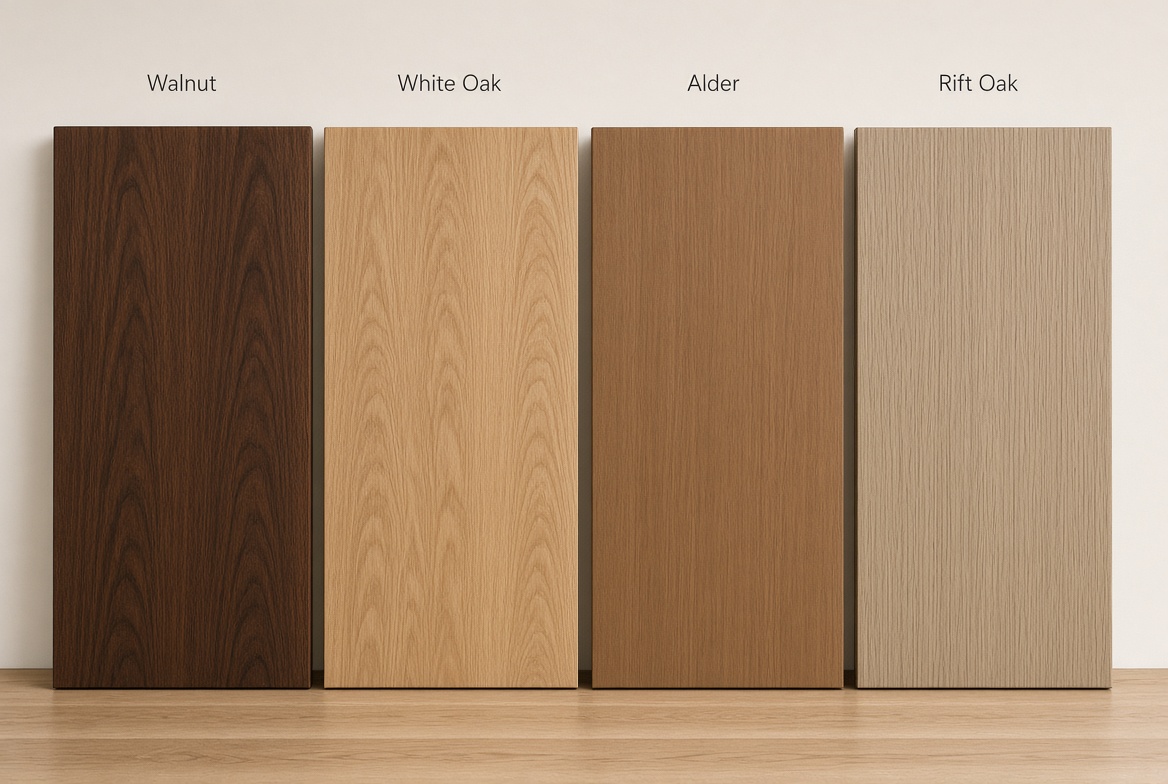
Same door style, same light. Walnut is the dark one.
A number doesn’t decide anything on its own. A well-built alder kitchen with eased edges and a durable topcoat will outlast a badly specified oak one. But if you’re choosing a material for a family island that takes a beating, the gap between 590 and 1,360 is not academic.
White oak: the default, and usually the right one

Plain-sawn white oak in a north-facing Vancouver kitchen — open grain, light base, room left for counters and walls.
White oak has a firm, open grain, takes both clear and pigmented finishes cleanly, and works in modern, transitional and Scandinavian rooms without looking like it’s trying. Its lighter base reflects more light, which gives you room to move on flooring, counters, backsplash and wall colour.
It’s also the most forgiving species for mixed or limited daylight — which describes a lot of Vancouver kitchens. A north-facing room or a mid-floor condo can carry white oak on every face without going gloomy, and that’s not true of walnut.
You can finish it nearly clear, lightly toned, or with a deeper stain, though a heavy stain removes most of the reason to have chosen oak. The one thing to check before approving: grain variation. Plain-sawn white oak has broad cathedral figuring that changes noticeably door to door, and that’s either the point or a problem depending on the design.
On finish, our painted vs stained comparison is worth reading alongside this — the finish decision moves a quote more than the species does.
Walnut: depth, at a price

Walnut on the island and stools only. Perimeter stays light so the room doesn’t read as one dark plane.
Walnut is the answer when the objective is richness and a quieter overall grain. Its natural brown makes a kitchen feel grounded, and because the colour is doing the work, you often don’t need a second contrasting finish at all.
It absorbs light, though. In a small or dim room, walnut on every cabinet face turns the kitchen into one continuous dark plane. It works better on an island, a tall bank or a feature wall, with the perimeter kept light. Pair it with pale counters, warm white walls and a restrained backsplash.
Calgary’s stronger daylight carries walnut more easily than Vancouver’s does, but strong sun brings its own issue: walnut lightens with UV exposure over years, in the opposite direction from cherry, which darkens. Ask for a finish with proper UV resistance and expect gradual change regardless. No clear coat stops it entirely.
At 1,010 Janka it’s plenty hard enough for daily use. The catch is visibility — a scratch on a dark surface shows more than the same scratch on oak, so a matte or low-sheen finish is easier to live with than a satin or gloss.
Alder: the stained look on a budget, with one real caveat
Alder has a fine, restrained grain and takes stain more evenly than most affordable hardwoods, which makes it the standard choice for a stained traditional or transitional kitchen where walnut pricing doesn’t fit. It’s also what a lot of BC-built cabinet lines use for their stained programmes.
The caveat is softness. At 590 Janka, alder dents from things that wouldn’t mark oak: a dropped pan, a belt buckle at the island, a chair pushed back hard. It doesn’t fail — it acquires marks. Some homeowners read that as patina and some read it as damage, and it’s worth knowing which one you are before you sign.
Where we steer people away from alder: island seating edges, the dishwasher end panel, waste pull-out fronts, and anywhere a mudroom bench takes daily impact. Where it works well: uppers, pantry doors, and any kitchen where the owner wants a warm mid-tone stain and would rather put the budget into drawer hardware.
One technical note your cabinetmaker should raise without being asked. Alder is blotch-prone — it absorbs stain unevenly across the board unless the shop uses a conditioner or a toned finishing schedule. A shop that hands you an alder sample without mentioning how they control blotching hasn’t thought about it.
Rift oak is a cut, not a species
This trips people up constantly. Rift oak is white oak, sawn at a different angle to the growth rings. Same tree, same hardness, different appearance and a meaningfully different price.

Rift-sawn white oak on a tall run. Same species as the kitchen above, different cut.
| Cut | Appearance | Yield from the log | Relative cost |
|---|---|---|---|
| Plain-sawn | Broad cathedral arches, high variation door to door | Highest | Baseline |
| Rift-sawn | Straight, linear, tight and consistent; no flake | Low | +15–30% |
| Quarter-sawn | Straight grain with visible medullary ray flecking | Low | +15–30% |
| Live-sawn | Mixed character across one board | Moderate | Varies |
Rift is worth specifying when grain direction is central to the design. Vertical lines let a tall pantry wall read as one calm surface, particularly with slab doors and integrated pulls, and it’s the right answer when broad cathedral figuring would fight a minimalist scheme.
It isn’t automatically better. Rift can look repetitive when every surface carries the same linear pattern, and a poorly matched run stands out more than it would in plain-sawn, precisely because the intended order is so obvious. Ask to see a full-size door, a drawer front and a tall panel — not a veneer chip.
Quarter-sawn is the one nobody asks about and some people should. The ray flecking gives you a Craftsman or Arts-and-Crafts character that suits a lot of the older housing stock in Vancouver’s east side and Calgary’s inner-city neighbourhoods.
Three more worth knowing about
Smoked oak
White oak treated with ammonia fuming or a reactive stain that darkens the tannins in the wood itself rather than sitting on top of it. The result is a deep grey-brown with the grain still fully legible. NKBA flagged it as one of the two species demand is shifting toward, alongside walnut, and almost nobody in either of our markets is showing it. If you want a wood kitchen that doesn’t look like everyone else’s white oak kitchen, this is the current answer.
Maple
Hard maple sits at 1,450 Janka with a tight, near-featureless grain. That makes it the best substrate for a painted door, which is why so many painted cabinet programmes are maple underneath. As a stained wood it’s less interesting, and it blotches worse than alder.
Ash
Oak-like grain, 1,320 Janka, and usually cheaper than white oak. It’s underspecified in Canadian kitchens, largely because it isn’t fashionable rather than because there’s anything wrong with it. Worth asking about if white oak pricing is stretching the budget.
Solid wood or veneer?
For most full kitchens the right answer is both: veneer on broad panels, solid wood on door frames and narrow components. That controls movement, keeps large surfaces consistent, and stops you paying for solid stock where it delivers nothing functional.
Veneer is real wood — a thin face layer bonded to a stable engineered core, not a printed imitation. Its limits are different from solid wood’s: deep sanding or a hard impact damages the face, and matching across doors takes planning. In a contemporary kitchen with lots of wide panels, that planning is exactly what you want.
Solid-wood doors suit framed designs but need room for seasonal movement. A wide solid panel held too tightly will cup, split, or telegraph movement through the finish. Good construction means proper joinery and finish applied to every exposed face and edge, including the ones nobody sees.
The cabinetmaker controls the substrate, the adhesive, the balancing layer, the edge treatment and the finishing schedule. The species name tells you nothing about whether a large end panel will stay flat — that’s a construction question, and our piece on 1-piece vs 5-piece door construction covers the doors specifically. For the boxes behind them, melamine vs plywood is the comparison that matters.
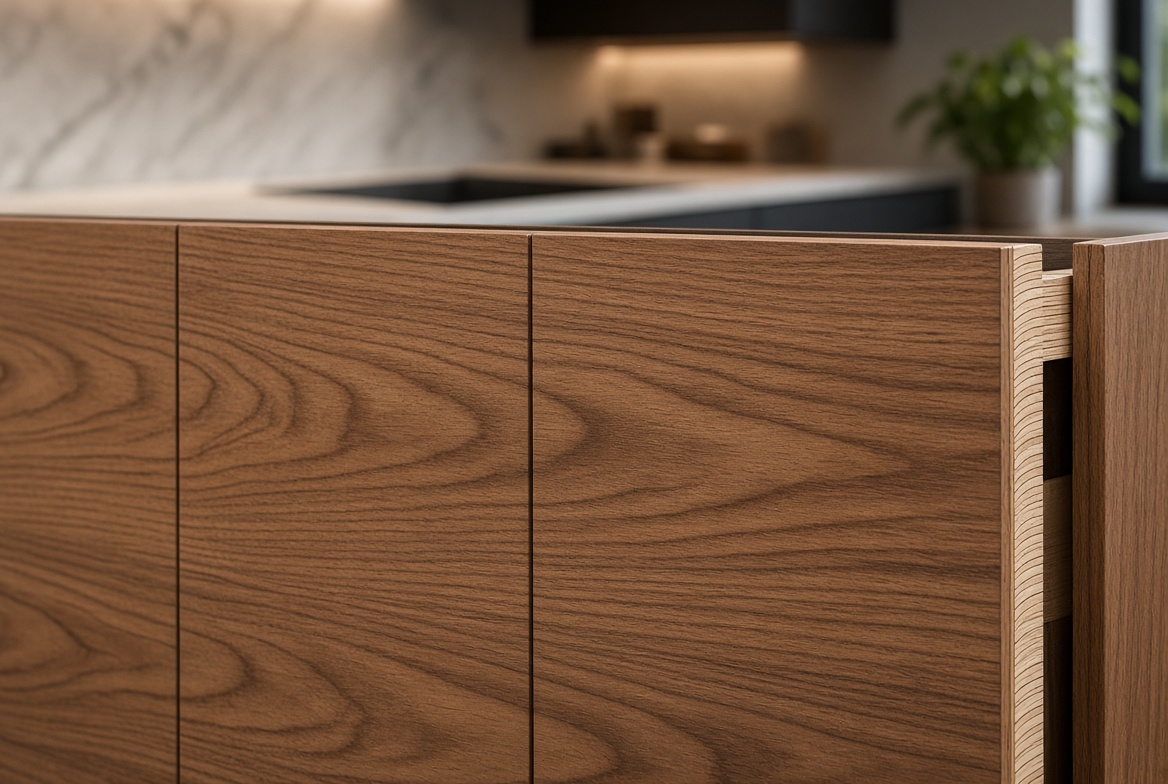
Sequence-matched veneer: the grain continues across the doors. That is a layout decision, not a species upgrade.
Confirm before shop drawings are approved:
- Door and drawer-front construction — solid, veneer or mixed
- Core material and edge-banding method for veneer panels
- Grain direction on doors, drawers, end panels and appliance panels
- Whether panels are sequence-matched or only colour-matched
- Finish sheen, stain formula, sample approval and expected colour variation
- Treatment of exposed ends, fillers, scribes and light-rail components
Planning grain around appliances and tall units
Grain direction gets resolved before fabrication or it gets resolved badly. Refrigerator panels, dishwasher panels, pantry doors and full-height end panels all need exact dimensions from the appliance manufacturer, and a late model change alters both the panel size and the visual rhythm of the run.
Specify whether grain runs vertically on tall doors and horizontally across drawers. A horizontal drawer bank beside vertical pantry doors can be exactly right, but it has to be a decision rather than an accident. Continuous grain across several doors is more demanding than colour matching and will increase both veneer use and labour.
Allow for fillers, scribes, ventilation and door clearances. A filler is a narrow finished strip that clears a wall, a corner or an adjacent door — it isn’t wasted space when it stops handles colliding or doors binding. Appliance model numbers need to exist before final drawings, which is the single most common cause of delay in our design-to-install timeline. For island dimensions and clearances specifically, the kitchen island size guide has the numbers.
Vancouver damp, Calgary dry: what each climate does to wood
This is the part of a species decision that gets skipped and shouldn’t. Wood moves with the moisture in the air around it, and our two markets sit at opposite ends of the range.
| Metro Vancouver | Calgary | |
|---|---|---|
| The condition | Consistently damp, especially October through March | Very dry winters; indoor humidity can drop into the teens |
| What it does | Wood takes on moisture and swells; doors can bind | Wood gives up moisture and shrinks; panels can open at joints |
| Where it shows | Sink base, dishwasher panel, anything near standing water | Wide solid panels, framed doors, mitred corners |
| Specification response | Sealed edges, moisture-tolerant box material, eased edges near water | Veneer over solid for wide panels, allowance for seasonal movement |
| Delivery and install | Acclimatise on site before install; keep away from open exterior doors | Don’t install into a house running a construction heater at low humidity |
| Ongoing | Wipe standing water at seams rather than leaving it | A humidifier through winter is genuinely worth it |
A hairline gap that opens at a mitred corner in February and closes again in July is wood behaving normally, not a defect. Knowing that in advance saves everyone a service call.
What each species costs
A full custom kitchen in Vancouver or Calgary generally runs $25,000 to $60,000 or more for the cabinetry package, before appliances, countertops, demolition and site repairs. Species moves the cabinet portion, not the whole renovation by the same percentage. For the full project picture, see the 2026 kitchen renovation cost breakdown for Canada and the Calgary budget ranges.
| Selection | Uplift over painted or stained alder | What drives it |
|---|---|---|
| Stained alder (baseline) | — | Standard profiles, fewer finished ends |
| Ash | +0–10% | Similar hardness to oak at lower material cost |
| Plain-sawn white oak | +5–20% | Clear finish, matched panels, extensive oak interiors |
| Rift or quarter-sawn oak | +15–30% | Low yield from the log, sequence matching, slab doors |
| Walnut | +15–35% | Select-grade veneer, full-height panels, integrated lighting |
| Smoked oak | +20–35% | Reactive finishing process, limited supply, sample approval |
Ways to control it without dropping the species: put the expensive wood on visible fronts and use a durable coordinated interior behind them. Restrict walnut to the island and tall bank. Specify rift on fronts without demanding it on every interior panel. Reduce the number of finished ends. None of those compromises show in the finished room.
A semi-custom line hits most of these looks below full-custom pricing — Merit vs Lectus, both built in BC, is the place to start if budget matters more than one-off dimensions. Both are also Canadian-made, which means the 25% surtax on imported cabinets doesn’t touch them. That matters more than usual right now: the measure is provisional and the Tribunal reports January 15, 2027, so an imported quote has a variable in it that a domestic one doesn’t.
A project that shows the split
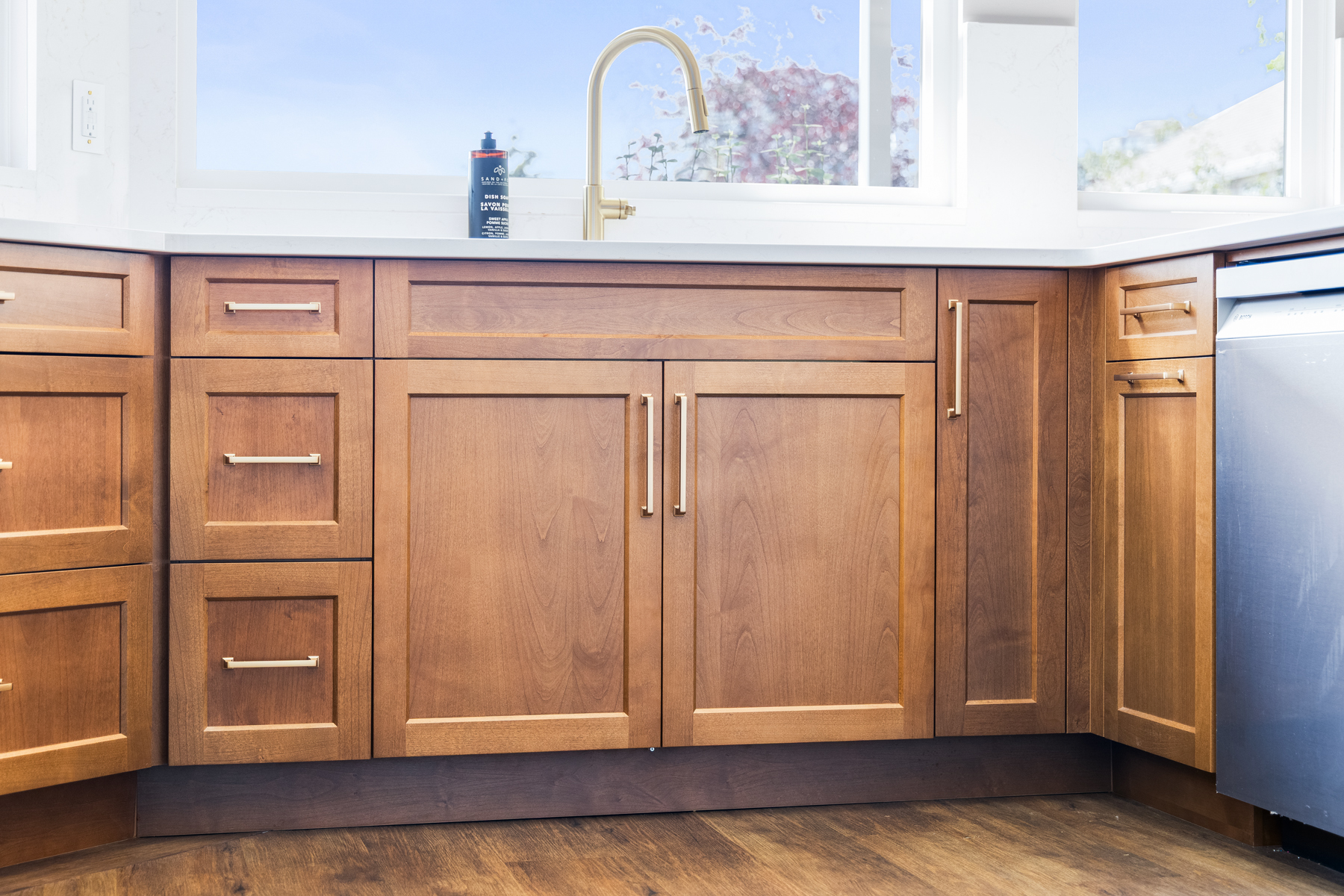
Our Warm Wood Kitchen is the clearest example we have of how to use wood without committing the whole room to it. Painted maple uppers in Arctic, stained alder lowers in Chicory, Beckham Flat doors, with Vicostone Golden Polaris on the counters and backsplash.
Three things that project gets right and worth stealing. The light finish is up high where it bounces daylight around, and the wood tone is down low where it grounds the room — the reverse arrangement makes a kitchen feel top-heavy. The maple takes paint flawlessly because of its tight grain, which is exactly what maple is for. And the alder sits on the lower run where a warm mid-tone stain reads beautifully, with the seating edge detailed to keep the softest material out of the highest-impact spot.
More finished rooms in the kitchen renovation portfolio. The useful exercise isn’t copying a photo — it’s noticing how much wood is actually in the frame and where the eye is given a quiet surface to rest.
What to ask before you choose a species
Ask for two samples, not one. A finish sample shows colour. A construction sample shows how the grain, edges, reveals and joints will actually look together, and it’s the one that prevents surprises.
Then get answers to these:
- Is the quoted price solid wood, veneer, or a combination — and on which specific parts?
- Which visible panels are included in the species upgrade? Doors, end panels, fillers, hood surround, interiors?
- How will natural variation be handled, and what range is considered acceptable?
- How is blotching controlled on the proposed stain, particularly on alder or maple?
- Is the panel layout sequence-matched or colour-matched?
- How will the finish be repaired — touch-up or door replacement?
- What UV resistance does the topcoat carry, and how much colour change should be expected in five years?
A quote that says “oak cabinets” without identifying the doors, end panels, fillers and interior parts can’t be compared to anything. If you’re still choosing who to work with, run our 12 questions to ask a cabinet maker on us first.
Making the call
White oak if you want the broadest design flexibility and strong everyday durability. Walnut if the darker tone is the design and the room has the light for it. Alder if a stained look and a controlled budget matter more than maximum hardness. Rift oak if straight grain and panel alignment justify the matching work. Smoked oak if you want the wood kitchen your neighbours don’t have yet.
Then look at the whole assembly, because species is one line in a much longer specification: door construction, core, finish schedule, edge profile, hardware, appliance panels and installation conditions. A well-built alder kitchen beats a badly specified oak one every time, and an expensive walnut package disappoints if the stain, the lighting or the grain layout was never resolved before production started.
Bring your flooring and countertop samples to either showroom and we’ll put full-size doors beside them under the lighting you’ll actually have, or book a free estimate and we’ll come to the room. Choosing wood from an online species chart is how the walnut-that-reads-red problem happens.
Vancouver: 604-293-1020 · Calgary: 778-996-5039
FAQ
Have wood cabinets really overtaken white?
Yes. The 2026 Houzz Kitchen Trends Study put wood-toned cabinetry ahead of white for the first time, 29% to 28%, and MasterBrand’s 2026 survey of more than 2,000 dealers and designers found white had dropped to fourth, behind light wood stains, creamy off-whites and mid-tone stains.
What is the best wood for kitchen cabinets?
White oak, for most kitchens. It rates 1,360 on the Janka hardness scale, takes clear and pigmented finishes well, reflects light in dim rooms and suits modern, transitional and Scandinavian designs. Walnut is better where you want depth and contrast; alder is the budget stained option.
Is rift oak a different wood from white oak?
No. Rift oak is white oak sawn at a different angle to the growth rings, producing a straight linear grain with no ray flecking. Same species, same hardness. It costs 15–30% more because the yield from each log is lower and the panels need sequence matching.
How hard is alder compared to oak?
Alder rates 590 on the Janka scale against white oak’s 1,360, so it’s roughly 40% as hard. It dents from impacts that wouldn’t mark oak. It’s a reasonable choice for uppers and pantry doors, and a poor one for island seating edges and high-traffic end panels.
Are walnut kitchen cabinets hard to keep clean?
No harder than any other finished wood. Wipe spills promptly, use a soft damp cloth and skip abrasive cleaners. The darker colour does make dust and light scratches more visible in raking light, so a matte or low-sheen finish is easier to live with than gloss.
What is smoked oak?
White oak darkened by ammonia fuming or a reactive stain that reacts with the tannins in the wood rather than sitting on the surface. The result is a deep grey-brown with the grain still fully visible. NKBA identified it as one of the species demand is shifting toward for 2027.
Should cabinet doors be solid wood or veneer?
Both, in most kitchens. Veneer on broad panels for dimensional stability and consistency, solid wood on door frames and narrow components. Veneer is real wood over a stable core, not a printed imitation, and it’s the better choice for wide contemporary panels.
Can I use two wood species in one kitchen?
Yes, but keep the hierarchy clear. One species should dominate and the second should be limited to an island, a tall wall or open shelving. Two similar stains that don’t quite match look accidental, so approve both samples together under the room’s actual lighting.
Is alder suitable for a rental or secondary suite?
It can be, if the expected use is moderate and the owner accepts visible wear. Alder dents more easily than oak, so it’s less forgiving in a high-turnover property. Durable hardware, eased edges and a medium-toned stain make marks less conspicuous.
Do natural wood cabinets increase resale value?
Not reliably by a measurable dollar amount. Wood can broaden appeal when the colour, layout and workmanship suit the home, but buyers also weigh storage, appliance condition and countertop quality. Choose the species for how you’ll live with it, not as an investment.
Does wood change colour over time?
Yes, and the direction depends on the species. Cherry darkens noticeably with UV exposure over the first few years. Walnut tends to lighten. White oak shifts subtly. A UV-resistant topcoat slows the change; nothing stops it.