Beyond the Surface: What Truly Determines the Longevity and Cost of Custom Kitchen Cabinets in Vancouver
Choosing the wrong custom cabinets can mean a $30,000 to $60,000 investment that fails within five years. We have been called to replace kitchens where doors are delaminating from steam, drawers are sagging under the weight of dishes, and finishes are peeling from routine cleaning. This happens when decisions are based on surface appearance rather than on material science and construction methodology. The longevity of custom kitchen cabinets in Vancouver is not determined by how they look on day one, but by the core materials, the joinery, and the quality of the hardware. Understanding these three elements is the only way to secure a return on your investment.
Key Takeaways
- Material is the primary cost driver: The choice between particleboard, MDF, plywood, and solid wood cores dictates both the price and the cabinet’s ability to withstand Vancouver’s climate.
- Construction defines durability: The difference between a 5-year and a 50-year cabinet lies in details like dovetail drawer boxes and full-dado joinery, not staples and screws.
- Lead times are a reality: A typical custom cabinetry project in the Lower Mainland takes 10 to 16 weeks from signed drawings to final installation, influenced by material sourcing and shop capacity.
- Finishes and hardware are not minor details: A high-quality conversion varnish finish and premium hardware from brands like Blum or Grass can account for 20-30% of the cost and are critical for daily use and longevity.

What Actually Determines the Cost of Custom Kitchen Cabinets?
The final price of a custom cabinet package is a direct function of three things: materials, labour, and hardware. For a standard 10×10 foot L-shaped kitchen, a baseline price for quality custom cabinets in Vancouver starts around $20,000 and can go to $50,000 or more. The primary variable is material selection.
- Materials (40-50% of cost): This includes the cabinet box (carcass), doors, drawer fronts, and any applied panels. A project using textured melamine on a particleboard core will be at the low end. A project using rift-cut white oak veneer on a plywood core with solid wood doors will be at the high end.
- Labour (30-40% of cost): This is the time required for design, cutting, assembly, finishing, and installation. A kitchen with simple, flat-panel doors is efficient to produce. One with complex mouldings, inset doors, or curved components requires significantly more bench time and finishing work, driving up the cost.
- Hardware & Finishes (10-20% of cost): This includes drawer slides, hinges, pulls, and the finishing products. Opting for premium undermount soft-close slides and a durable conversion varnish finish adds cost upfront but is essential for a high-functioning, long-lasting kitchen.
Material Tiers and Performance
Choosing the right material is a balance of budget, aesthetics, and performance. In Vancouver’s damp climate, moisture resistance is a key factor, especially around sinks and dishwashers.
| Material Type | Core Composition | Best Use Case | Cost Tier (1-5) | Expected Lifespan | Tradeoffs |
|---|---|---|---|---|---|
| TFL/Melamine | Particleboard | Budget-conscious projects, closets, pantries | 1 | 5-10 years | Low moisture resistance, chips easily, low screw-holding strength. |
| Painted MDF | Medium-Density Fiberboard | Painted doors, decorative panels | 3 | 15-25 years | Very stable, won’t crack at joints. Heavy, swells with direct water contact. |
| Domestic Plywood | Fir or Birch Plywood | Cabinet boxes (carcasses), shelves | 3 | 25-50+ years | High strength, moisture resistant, excellent screw-holding. Can have voids. |
| Veneered Plywood | Plywood core with wood veneer | High-end cabinet boxes, doors | 4 | 25-50+ years | The look of solid wood with the stability of plywood. Costly. |
| Solid Wood | Maple, Oak, Walnut | Drawer boxes, door frames, face frames | 5 | 50+ years | Strong, repairable. Expands and contracts with humidity, can warp. |

How Are Quality Cabinets Built?
The difference between a cabinet that feels solid and one that racks and sags is in the construction of the box, drawers, and joints. Mass-produced cabinets prioritize speed and low cost, often using staples and plastic components. True custom cabinetry prioritizes strength and longevity.
Cabinet Box Construction
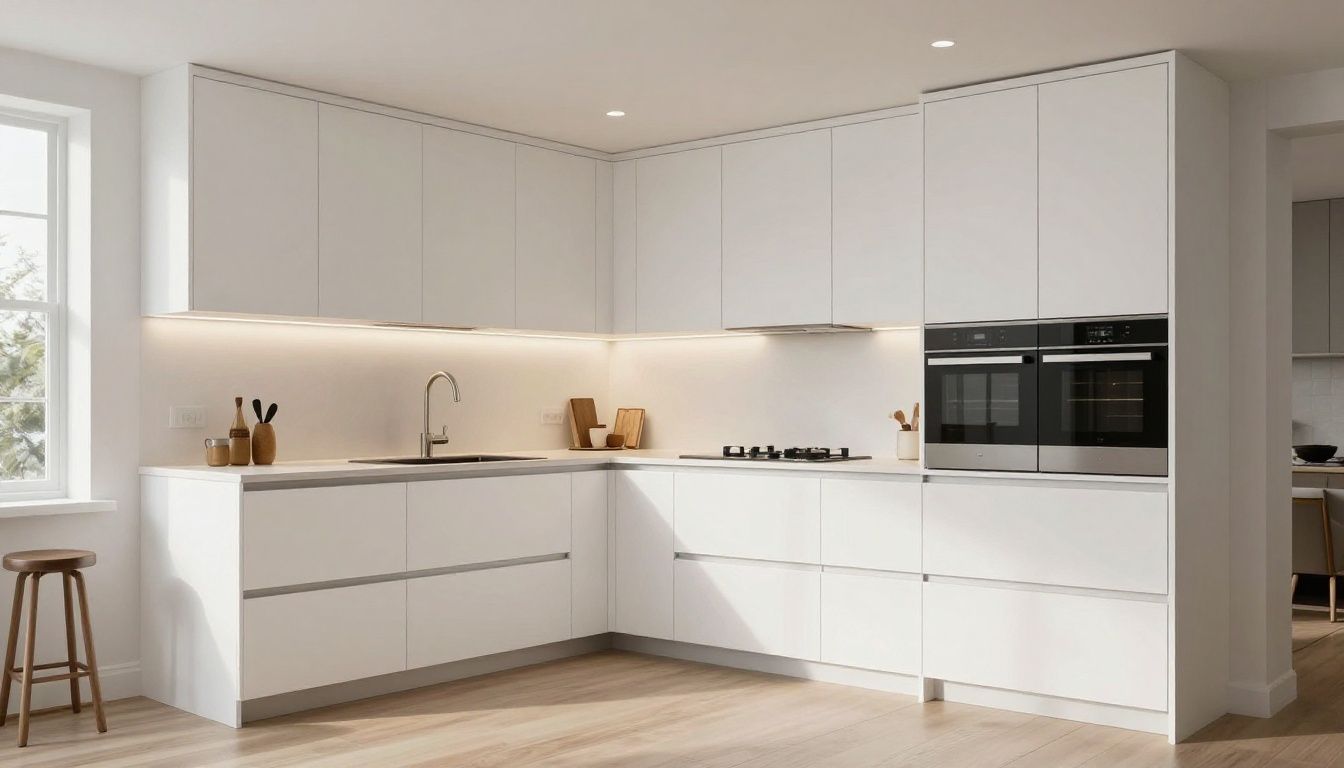
The standard for modern, high-end custom kitchen cabinets in Vancouver is frameless (or “Euro-style”) construction. This provides fuller access to the cabinet interior and a cleaner, more contemporary look. The integrity of a frameless cabinet depends entirely on the box.
- Low-Quality: 1/2″ or 5/8″ particleboard gables (sides), thin 1/8″ hardboard back that is stapled on, plastic leg-levelers.
- High-Quality: 3/4″ plywood gables, a solid 5/8″ or 3/4″ plywood back that is captured in dado (groove) joints, and integrated plywood toe-kicks or strong adjustable legs. A solid back keeps the cabinet square and rigid for decades, preventing doors and drawers from becoming misaligned.
Drawer Box Construction
A drawer is the most mechanically stressed part of a kitchen. We once serviced a kitchen where the drawer fronts had detached completely because they were only stapled to thin particleboard sides. The client had to replace all their lower cabinets after only seven years.
- Low-Quality: Stapled particleboard or metal sides with a thin bottom.
- High-Quality: 5/8″ solid wood (typically maple or birch) sides with dovetail joints at all four corners and a captured 3/8″ plywood bottom. Dovetail joints are a mechanical lock that is exceptionally strong and resistant to pulling apart from the thousands of open/close cycles a drawer endures.

What Are the Real Lead Times for Custom Kitchen Cabinets in Vancouver?
Planning a renovation requires a realistic timeline. The process for custom cabinetry is sequential, and rushing any step compromises the final quality. From the day you approve the final shop drawings and submit a deposit, expect a lead time of 10 to 16 weeks for a complete kitchen.
Here is a breakdown of a typical project timeline. The primary variables are the complexity of the project and the availability of non-standard materials, which can add weeks to procurement.
| Phase | Typical Duration | What Happens During This Phase |
|---|---|---|
| Design & Quoting | 1–3 Weeks | Initial consultation, site measure, material selection, drawing creation. |
| Client Approval & Deposit | 1 Week | Final review of shop drawings, contract signing, deposit payment. |
| Material Procurement | 1–4 Weeks | Ordering of all sheet goods, solid wood, hardware, and finishes. |
| Production & Finishing | 4–8 Weeks | CNC cutting, edge banding, assembly, sanding, finishing (multi-coat process). |
| Delivery & Installation | 3–7 Days | Delivery of cabinets to site, professional installation, hardware fitting, adjustments. |
| Total | 10–16 Weeks | From approved drawings to a functional kitchen. |
Which Finishes and Hardware Should I Choose?
Finish and hardware are the primary points of interaction with your cabinets. They must be durable and functional.
Finishes
For painted or stained cabinets, the industry standard for high-end work is a post-catalyzed conversion varnish. This is a two-part finish that undergoes a chemical reaction as it cures, creating a hard, durable surface that is highly resistant to chemicals, moisture, and scratches. It is far superior to lacquer or consumer-grade polyurethane. The finishing process involves multiple rounds of sanding, priming, and top coats in a dedicated spray booth, and is a significant part of the cabinet’s cost and quality.
Hardware
- Drawer Slides: The standard for quality is a full-extension, undermount slide with an integrated soft-close mechanism. Brands like Blum and Grass are industry leaders. Undermount slides are invisible when the drawer is open and provide better support than older side-mount styles.
- Hinges: For frameless cabinets, concealed soft-close hinges are standard. They offer six-way adjustability, allowing installers to create perfect, consistent gaps between all doors.
Investing in quality hardware from reputable manufacturers ensures smooth, silent operation for the life of the cabinets. It is a small part of the total cost where saving a few hundred dollars is a poor economy.

When planning a renovation, the quality of your custom kitchen cabinets in Vancouver will have the most significant impact on the daily function and long-term value of your home. The choices made regarding core materials, construction methods, and hardware are what separate a beautiful, lasting kitchen from a costly mistake.
When you are ready to proceed with a design, Final Draft Cabinetry can provide a detailed, transparent quote based on your architectural plans. Contact our team in Vancouver, Burnaby, or Calgary to schedule a consultation and ensure your investment is built to last.
Frequently Asked Questions
1. How much should I budget for custom cabinets in a kitchen renovation?
For a mid-to-high-end kitchen renovation in Vancouver, which can range from $80,000 to $150,000+, you should allocate 30-40% of the total budget to cabinetry. This means a cabinet budget of $24,000 to $60,000 is a realistic starting point for a quality custom project.
2. Is frameless cabinetry less durable than framed?
No. When built correctly with 3/4-inch plywood boxes and solid backs, modern frameless cabinets are exceptionally strong and rigid. This construction method, dominant in the European market for decades, offers superior interior access and a clean aesthetic without sacrificing durability.
3. Why is plywood better than MDF for cabinet boxes?
Plywood offers superior structural strength, moisture resistance, and screw-holding power compared to MDF or particleboard. While high-quality MDF is an excellent, stable substrate for painted doors, plywood is the preferred material for cabinet carcasses that need to support heavy countertops and last for decades.
4. Can you match the style of my existing 1990s oak cabinets?
Yes, a core competency of a custom shop is the ability to replicate existing designs. We can match door profiles, wood species, and stain colours. However, achieving a perfect match to a 30-year-old, faded finish can be complex and may require multiple samples to get right.
5. Do you install the cabinets you build?
Yes. We believe the builders should be the installers. Our own team installs all our work to ensure accountability. This eliminates communication problems between a separate builder and installer and guarantees that the final fit and finish meet our shop’s quality standards.
6. What warranty do you offer on your cabinetry?
We provide a limited lifetime warranty to the original owner that covers defects in materials and workmanship for our cabinet boxes and drawer construction. Hardware like slides and hinges are covered by the manufacturer’s warranty, which is also typically for the lifetime of the product.