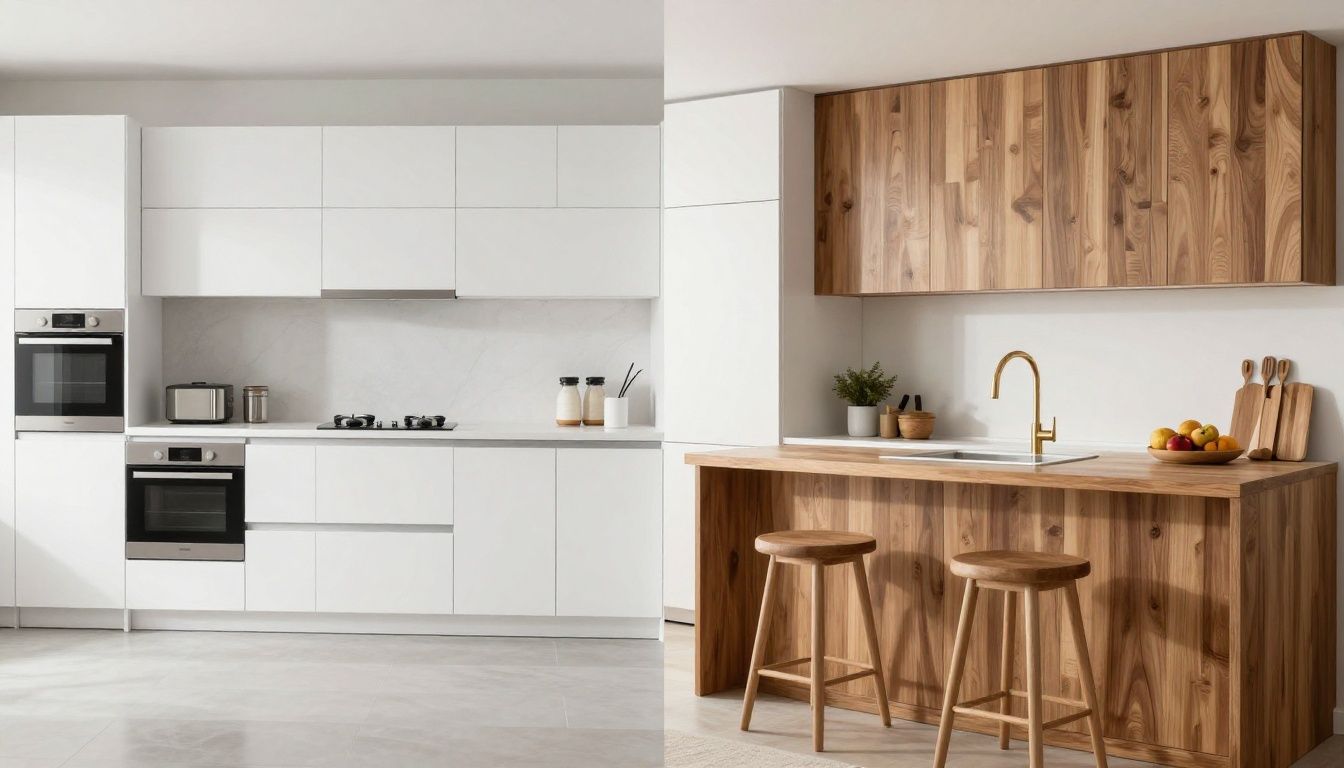
Melamine vs. Solid Wood Cabinets: Durability, Moisture Behaviour, and Cost Over a 15-Year Horizon
Choosing the wrong cabinet material for your climate can lead to a complete failure within five years. We once replaced a set of solid poplar doors in a Vancouver basement suite that had warped beyond adjustment due to ambient humidity. The cost to the client for that mistake was over $5,000 for new doors alone. The core issue was a misunderstanding of how materials behave. The decision in the melamine cabinets vs wood debate is not about which is generically “better,” but which is technically correct for the specific application, environment, and budget. The answer is determined by engineering trade-offs, not marketing.
Key Takeaways
- Stability and Moisture: Melamine offers superior dimensional stability and moisture resistance, making it the preferred choice for humid or variable climates like Vancouver’s.
- Durability and Repair: Solid wood is softer and dents more easily but is repairable. Melamine is highly scratch-resistant, but significant damage often requires full component replacement.
- Cost and Value: Melamine typically has a 20-40% lower initial cost. Over a 15-year horizon, high-quality melamine often has a lower total cost of ownership due to its low maintenance requirements.
- Construction: Most “solid wood” kitchens use solid wood only for doors and face frames; the cabinet boxes are almost always plywood or particleboard, similar to melamine cabinet cores.
- Aesthetics: Modern textured and laser-edged melamine can produce a high-end, seamless look that solid wood cannot, especially for large panels or
kitchen cabinets to ceiling.

What Is the Real Difference in Material and Construction?
Understanding the fundamental composition of each material is the first step in making an informed decision. The terms are often used loosely, which creates confusion.
Melamine (Thermally Fused Laminate)
Melamine is not a solid plastic. It is a composite wood product. The proper term is Thermally Fused Laminate (TFL), also known as melamine. It consists of three layers:
- Substrate: The core is typically particleboard or Medium-Density Fiberboard (MDF). The quality of this substrate is the single most important factor in the panel’s durability and longevity. We use industrial-grade, high-density particleboard for its structural integrity and screw-holding capacity.
- Decorative Paper: A layer of paper printed with a color or pattern (such as a wood grain) is placed on the substrate.
- Resin: The decorative paper is saturated with a melamine resin. This assembly is fused directly to the substrate under high heat and pressure, creating a permanent bond.
The result is a finished panel that is stable, consistent, and has a hard, durable surface. The edges are then sealed with edge banding, a thin strip of PVC, ABS, or melamine that is glued or, for a superior finish, laser-welded on.
Solid Wood
When we refer to solid wood cabinets, we are primarily talking about the doors, drawer fronts, and face frames (the visible frame on the front of the cabinet box). Common hardwood species include maple, oak, cherry, and walnut. Each has different hardness, grain, and cost.
A critical point of clarification: the cabinet box itself—the sides, top, bottom, and back—is almost never made of solid wood. Solid wood is too heavy, expensive, and prone to warping in large sheets. Instead, cabinet boxes are constructed from furniture-grade plywood or, in some cases, the same particleboard used for melamine cabinets. Therefore, a cabinet material comparison is often a comparison between a melamine door on a particleboard box and a solid wood door on a plywood box.
How Do Melamine and Wood Cabinets Handle Moisture and Humidity?
This is arguably the most critical performance difference, especially in coastal regions like Vancouver or areas with significant seasonal humidity shifts like Calgary.
Melamine’s Performance
The fused melamine surface is non-porous and completely waterproof. Water can sit on the face of a melamine door indefinitely without causing damage. The material’s weakness is its edges and any deep scratches that penetrate the surface. If water reaches the particleboard substrate, it will swell. This is why the quality of the edge banding is paramount.
- Glue-On Edge Banding: The standard method. It provides a good seal, but the glue line can be a point of failure over many years if exposed to constant moisture or heat.
- Laser Edge Banding: This technology uses a laser to melt a polymer layer on the back of the edge band, fusing it directly to the panel. The result is a seamless, monolithic edge with no glue line. It is far more resistant to heat, moisture, and delamination, and is our standard for all high-use areas like kitchens and bathrooms.
Solid Wood’s Performance
Wood is hygroscopic, meaning it naturally absorbs and releases moisture from the air. This causes it to expand in humid conditions and contract in dry conditions. This movement is a fundamental property of the material.
- Expansion and Contraction: A five-piece solid wood door is designed to allow for this movement. The central panel floats within the frame. However, significant or rapid humidity swings can overwhelm this design, leading to warped doors that no longer sit flat against the cabinet, or hairline cracks in the finish at the joints.
- Finishing: A high-quality factory finish with multiple coats of lacquer or conversion varnish slows moisture exchange significantly but does not eliminate it. It provides protection against spills but not against ambient humidity over the long term.
For a home with inconsistent climate control, solid wood requires accepting a certain amount of seasonal movement. Melamine, by contrast, is dimensionally inert.

Which Material Is More Durable for a Family Kitchen?
Durability must be assessed in two categories: surface wear and impact resistance.
Surface Wear: Scratches, Stains, and Heat
Here, melamine has a clear advantage. The fused resin surface is extremely hard. It is highly resistant to scratches from everyday use, staining from food spills, and damage from heat. You can clean it with almost any household cleaner without fear of damaging the finish. This makes it an excellent choice for the best kitchen cabinet doors in a high-traffic family environment.
Solid wood, being a softer natural material, is more susceptible to surface damage. A dragged piece of cutlery can scratch the finish and the wood beneath. Abrasive cleaners can dull the lacquer. While durable, it requires more careful use.
Impact Resistance and Repairability
This is where the trade-off occurs. If you strike a solid wood door with a heavy object, it will likely dent or gouge. This damage, however, is almost always repairable. A skilled technician can fill the dent, sand it, and touch up the finish to make the damage nearly invisible.
If you strike a melamine door with the same force, especially at a corner or edge, you can chip the surface or crush the particleboard substrate underneath. This type of damage is not repairable. The only solution is to replace the entire door or panel. While the surface is harder to damage initially, the consequences of damage are more severe.
A brief scenario: A client with three young children was deciding between the two materials. We showed them two sample doors. We made a small dent in the solid wood door with a hammer, then filled and touched it up in a few minutes. We then struck the corner of the melamine door with the same force, causing a chip that exposed the light-coloured substrate. The visual demonstration made the trade-off clear: wood’s repairability versus melamine’s surface hardness. They chose a textured melamine, accepting the risk of non-repairable damage in exchange for superior daily scratch resistance.
What Is the Cost Difference Over the Life of the Cabinets?
When comparing melamine cabinets vs wood, it is essential to look beyond the initial quote and consider the total cost of ownership over a 15- to 20-year period. The initial investment for solid wood is significantly higher, and it carries potential future costs that melamine does not.
Below is a comparison table based on a standard 10’x10′ L-shaped kitchen. Costs are estimates and will vary based on layout, features, and market conditions in Vancouver or Calgary.
| Feature | High-Quality Melamine (TFL) | Solid Wood (e.g., Maple) |
|---|---|---|
| Initial Cabinet Cost | $12,000 – $18,000 | $18,000 – $30,000+ |
| Installation | Included in cabinet cost; requires precision. | Included in cabinet cost; requires scribing. |
| Typical Maintenance | Regular cleaning. | Regular cleaning; careful with moisture. |
| Potential 15-Year Costs | $0 – $500 (e.g., replace one damaged door) | $4,000 – $8,000 (full refinishing) |
| Repairability | Low. Damage often requires replacement. | High. Dents and scratches can be repaired. |
| Estimated 15-Year Total | $12,000 – $18,500 | $22,000 – $38,000+ |
As the table shows, the primary long-term financial risk with solid wood is the eventual need for refinishing. After 10-15 years of use, the finish on wood cabinets, particularly around sinks and handles, can wear down. A full professional refinishing job is a major undertaking. Melamine, if undamaged, will look virtually the same in 15 years as it did on day one, with no additional investment required.

Can You Achieve a High-End Look with Melamine?
Yes. The perception of melamine as a cheap, low-quality material is outdated and based on the thin, paper-like laminates used on low-end furniture from decades ago. Modern, high-quality TFL is a premium product used in high-end architectural and commercial projects.
Texture and Finish
Leading manufacturers like Tafisa and Uniboard offer extensive palettes. You can select from:
- Deeply Embossed Textures: These are synchronized with the printed wood grain underneath, creating a remarkably realistic look and feel that mimics rift-cut oak or rustic hickory.
- Super-Matte Finishes: These have anti-fingerprint properties and a soft, luxurious appearance that is difficult to achieve with a painted finish.
- Solid Colors and Patterns: From concrete and linen looks to bold solid colors, the design flexibility is immense.
Seamless Construction
Because melamine is engineered, it is perfectly flat and stable. This makes it the ideal material for modern, minimalist designs with large doors and panels. It is the best choice for achieving floor-to-ceiling cabinets, as a solid wood door of that height would be unacceptably prone to warping. The use of laser edge banding creates a clean, monolithic appearance that is impossible to replicate with a five-piece solid wood door, which will always have visible joint lines.

What Are the Installation and Repair Considerations?
On-site realities also play a role in material selection.
Installation: Melamine cabinets are typically built using frameless construction, which relies on the cabinet boxes themselves for structure. The panels are heavy and must be installed perfectly level and plumb. There is little room for error. Solid wood face-frame cabinets are more forgiving. The face frame adds rigidity and provides a margin for scribing—trimming the edge of the cabinet to fit perfectly against an uneven wall. An installer can more easily adapt a wood cabinet to an older, out-of-square house.
Repair: As noted, this is wood’s primary advantage. A wood kitchen can be seen as a single, repairable entity. Scratches can be buffed out, dents filled, and the entire kitchen can be sanded and refinished for a completely new look decades down the line. A melamine kitchen is a collection of individual components. If one is damaged, it is replaced. You cannot change the color or finish of your melamine kitchen without replacing all the doors and exposed panels.
Frequently Asked Questions (FAQ)
1. Is melamine toxic or does it off-gas?
Modern, high-quality particleboard and MDF substrates are engineered to meet strict emissions standards, such as CARB 2. The melamine resin surface itself is inert and stable once cured, and does not off-gas. It is a safe material for home use.
2. Can you paint melamine cabinets?
While technically possible with extensive prep work and specialized primers, it is not recommended. The paint will not be as durable as the original fused surface and is prone to chipping and peeling. It is a short-term fix that compromises the material’s primary benefits.
3. Does solid wood always warp?
All solid wood moves with changes in humidity. Warping is the extreme result of this movement. High-quality construction, proper finishing, and a stable home environment with controlled humidity (as recommended by the NKBA Kitchen Planning Guidelines) will prevent significant warping, but minor seasonal movement at the joints is normal.
4. How long do melamine cabinets last compared to wood?
Well-made cabinets of either type can last 20-30 years or more. The failure mode is different. Melamine cabinets fail from substrate swelling due to water intrusion or irreparable impact damage. Wood cabinets fail from joint separation, finish wear, or warping.
5. Is one material better for home resale value?
This depends entirely on the style of the home and the target buyer. In a modern condo or a contemporary new build, a high-end melamine kitchen is often more desirable. In a traditional or transitional style home, buyers may expect to see solid wood.
6. What about wood veneer as a compromise?
Wood veneer—a thin layer of real wood applied to a particleboard or MDF core—offers the aesthetic of real wood with the stability of an engineered substrate. It is an excellent product. However, it shares melamine’s low repairability; a deep scratch or chip cannot be easily fixed.
Conclusion: Making the Right Technical Choice
The melamine cabinets vs wood decision should be guided by an honest assessment of your priorities, home environment, and tolerance for maintenance. Melamine offers superior performance in stability, moisture resistance, and surface durability at a lower price point. Solid wood offers traditional aesthetics, the unique character of a natural material, and the significant advantage of being repairable and refinishable.
If your project demands precision, a consistent modern aesthetic, and resilience in a humid or high-use environment, high-quality melamine is the superior technical choice. If your design calls for classic character and you value the ability to repair and refinish your investment over decades, solid wood remains the standard. A detailed consultation with an experienced cabinetmaker is the best way to analyze these trade-offs for your specific project.