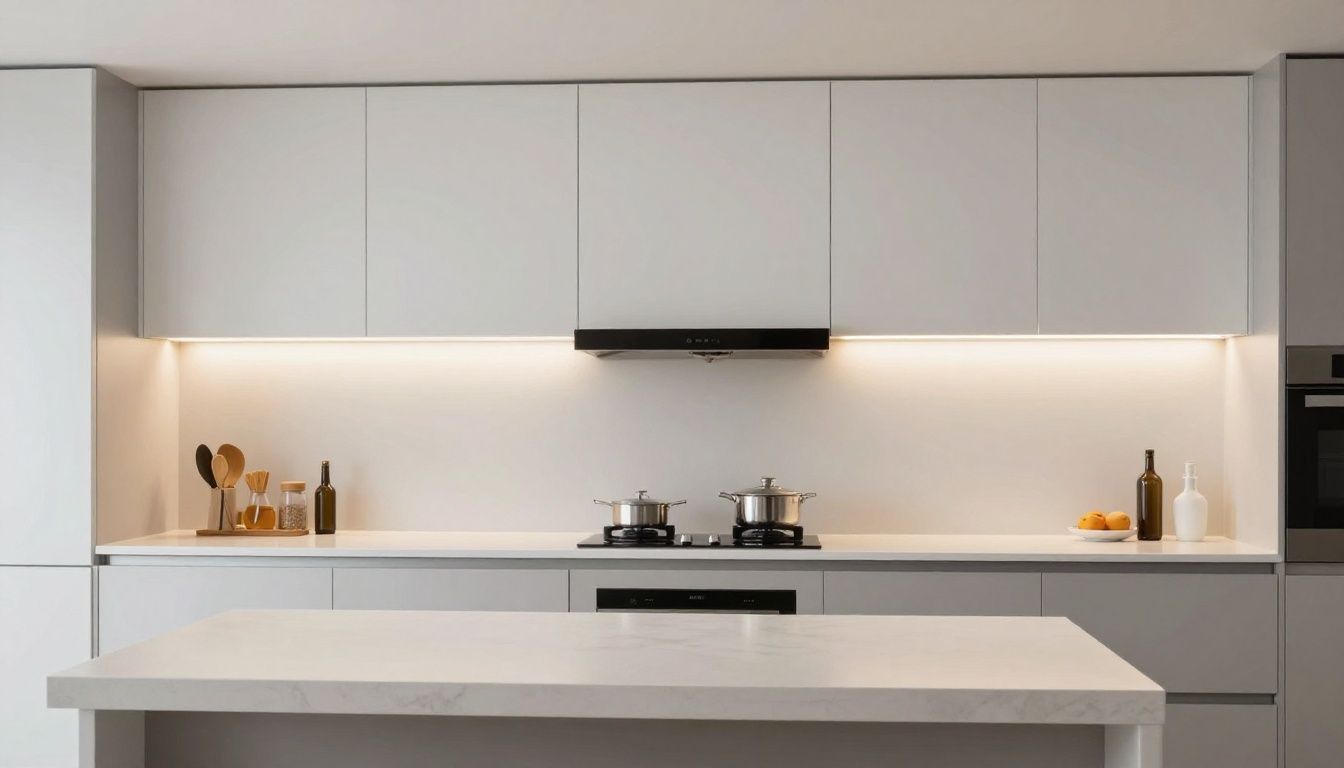
Under Cabinet Lighting Guide: LED Strips vs Puck Lights vs Linear
Installing improper task lighting creates immediate, measurable functional deficits in a workspace. If your fixtures are improperly spaced, you will deal with erratic shadows across your countertops or glare reflecting directly into your eyes from the front edge of the cabinets. When light sources are poorly integrated into the cabinet face frame, you compromise the clean aesthetic of your work surface. Selecting the wrong solution leads to uneven illumination, short-lived diodes, and costly modifications to finished millwork. The primary goal is consistent, task-focused illumination that highlights the workspace without distracting from the cabinetry itself. A successful outcome requires choosing between continuous LED strips, circular puck lights, or rigid linear fixtures based on your cabinet layout and electrical capacity.
Key Takeaways
- LED strips provide the best uniform coverage across long spans.
- Puck lights create discrete pools of light, which may result in dark gaps between units.
- Hardwired systems offer the cleanest, most reliable integration compared to plug-in alternatives.
- Proper lighting design for kitchen cabinets begins during the framing phase, not after installation.
LED Strip Lights for Kitchen Tasks
LED strips consist of flexible circuit boards populated with diodes. They are the standard for contemporary custom kitchens because they provide a near-continuous line of light that eliminates the spotting effect associated with cheaper hardware. When installed in an aluminum profile with a frosted diffuser, they project light evenly onto the landing area of your countertop.
Their primary advantage is flexibility. You can cut these strips to exact lengths, meaning every inch of your cabinet underside is illuminated. However, the quality of the light depends on the diode density—measured in LEDs per meter. High-density strips prevent the reflection of individual light points on glossy countertops, often referred to as hot-spotting. For a guide on how to integrate these properly, refer to lighting design for kitchen cabinets.

Puck Lights: When to Use Them
Puck lights are small, circular fixtures providing localized beams of light. They are effective in kitchens with specific architectural constraints that prevent the use of linear runs, such as very small corner cabinets or glass-bottom display units. One recurring issue is that puck lights create distinct “cones” of light. If spaced too far apart, you will encounter significant transition zones where the countertop remains in shadow.
From a builder’s perspective, puck lights require more precise site-level layout work. If you choose this route, you must ensure the installer accounts for the wiring clearances inside the cabinet carcass. Consider the structural implications of your build by reading about how the build process affects final results in From Design to Done: Understanding the Custom Cabinet Installation Timeline.
| Feature | LED Strips | Puck Lights | Linear Fixtures |
|---|---|---|---|
| Light Distribution | Uniform | Spotted | Uniform |
| Installation Complexity | Moderate | High (requires more holes) | Low (pre-wired) |
| Visual Profile | Low | Visible | Moderate |
| Best For | Long runs, workspaces | Display cabinets, corners | Retrofit, simple plug-in |

Linear Fixtures and Wiring Considerations
Rigid linear fixtures are self-contained bars. They are easier to install than custom-cut LED strips because the transformer and housing are already integrated. While they simplify the labor, they lack the low-profile elegance of recessed strip channels.
Regarding wiring, hardwired connections are superior for longevity and safety. Plug-in systems, while superficially convenient, involve cords that occupy outlet space and create clutter. If you are serious about the longevity and long-term cost of your cabinetry systems, it is worth understanding the value of an integrated, clean build as outlined in What Truly Determines the Longevity and Cost of Custom Kitchen Cabinets in Vancouver.

Maintenance and Long-term Performance
High-quality under cabinet lighting should last for the duration of the cabinetry’s life. However, maintenance depends on the modularity of the components. Drivers—the device that converts line voltage to low voltage—should be accessible for replacement if they fail. Do not seal drivers behind drywall or permanent masonry. Once your installation is complete, follow established protocols, as outlined in our Maintaining Your Investment: A Cabinet Care Guide for Vancouver Homeowners, to keep all electrical components free of debris and moisture.

FAQ
What color temperature is best for under cabinet lighting?
3000K to 3500K is the industry standard for most kitchens. This range provides a warm, natural light that ensures food preparation surfaces appear true to color without the harsh blue tint associated with 5000K or higher bulbs.
Can under cabinet lighting be dimmed?
Yes, provided you match the LED driver to the dimming protocol of your wall switches. Always verify compatibility between your lighting system and your chosen wall-mounted dimmer before finalized electrical rough-in to prevent the light from flickering.
How far should lights be placed from the wall?
To minimize glare and maximize illumination on the work surface, fixtures should be placed within the front third of the cabinet depth. This positions the light source directly over the counter area where you perform manual tasks, rather than flooding the backsplash.
Is it better to power lights individually or from a single driver?
Powering from a single, centralized driver is generally the more robust choice for residential applications. It reduces the number of failure points and simplifies switching, allowing a single wall control to operate all under-cabinet zones simultaneously throughout the kitchen.
Properly specified under cabinet lighting distinguishes a functional kitchen from a standard one. If you are finalizing your cabinet plans, bring your layout designs to a professional shop to ensure all lighting channels are integrated during production rather than added as a disruptive afterthought. Final Draft Cabinetry recommends planning your electrical schematic alongside our fabrication process to ensure a clean, long-lasting installation.