Wood and Butcher Block Countertops in Vancouver: Materials, Cost and Care
A poorly sealed wood counter around a Vancouver sink can darken, swell, and require replacement long before the cabinets do. A realistic installed price is roughly $150–$350 per square foot for a properly fabricated and finished wood top, with species, construction, edge details, sink cutouts, finishing, and site conditions driving the range. Wood kitchen countertops in Vancouver are practical when used in the right location and maintained correctly; they are usually a better choice for an island or accent run than for every wet work surface.
Key takeaways
- Edge-grain hardwood is the practical default for most wood kitchen countertops in Vancouver, while end grain costs more and face grain shows more movement.
- Budget approximately $150–$350 per square foot installed; demolition, sink cutouts, backsplash work, premium species, and complex access can increase the total.
- Wood performs best when finished on every surface, kept dry around seams, and maintained with the product specified by the fabricator.
- A wood island paired with quartz perimeter counters gives warmth where it matters and water resistance where work is wettest.
- A custom fabricator should review sink type, overhangs, appliance clearances, humidity, and the maintenance schedule before ordering material.
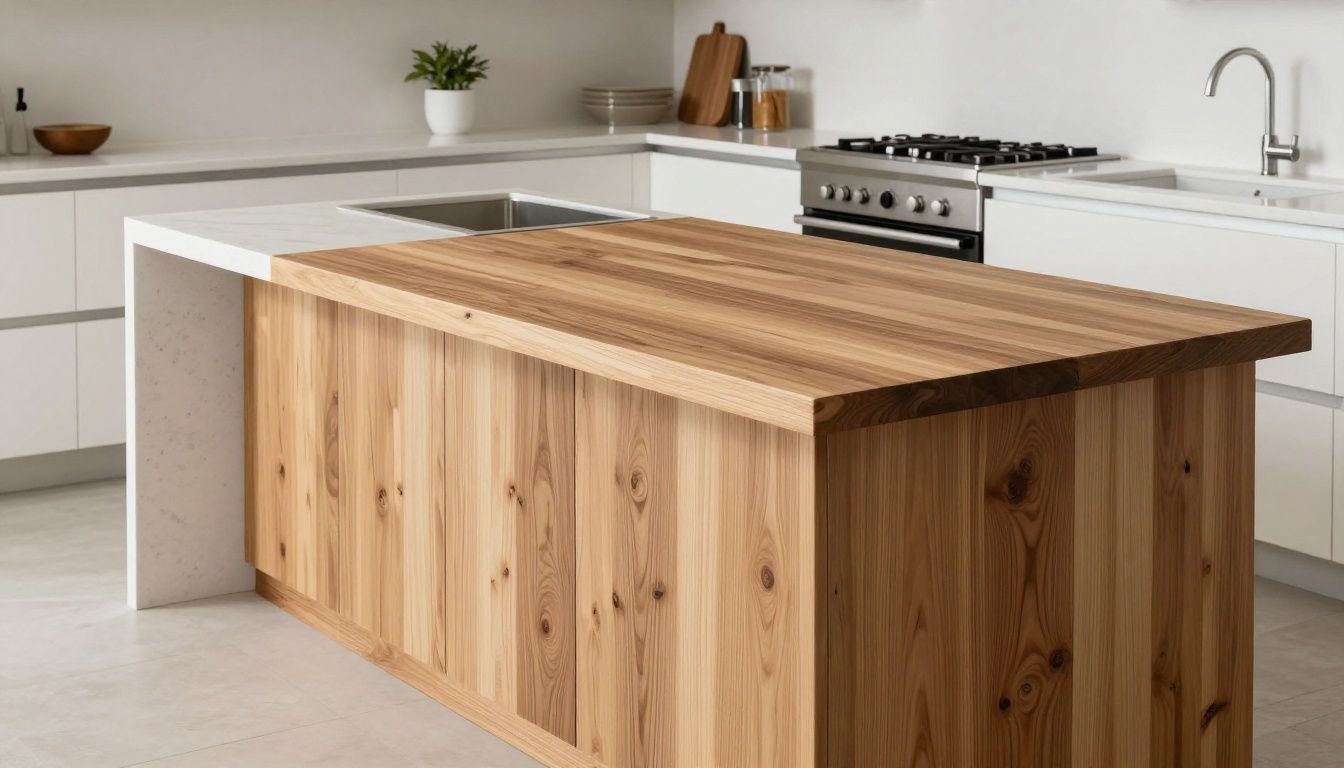
An island is often the most practical place to use wood, while quartz handles the sink and cooking perimeter.
Is wood a practical countertop material in Vancouver?
Yes, but not as a maintenance-free surface. Vancouver’s damp climate does not automatically damage a wood counter; repeated wetting, trapped moisture, heat, and uneven sealing do. A well-built top can remain serviceable for many years, but it needs more attention than quartz or porcelain.
The important distinction is between ambient humidity and liquid water. Seasonal humidity changes cause wood to expand and contract across its grain. That movement is expected and must be allowed for in the fabrication and installation. Water sitting at a sink rim, dishwasher edge, or unsealed end is a more immediate problem because it can enter joints and end grain.
For many Metro Vancouver renovations, the best layout is a wood island, breakfast ledge, or short accent run. The main sink, dishwasher, and frequently splashed preparation area can use quartz. This arrangement reduces exposure without removing wood from the room’s visual and tactile focal point.
Before selecting a species, review the broader material and layout decisions in this guide to designing your dream kitchen with the right kitchen cabinets. Countertop depth, cabinet support, appliance placement, and edge conditions should be resolved together rather than treated as separate orders.
Which wood construction is best: edge grain, end grain, or face grain?
For most residential counters, edge grain is the best balance of stability, cost, and appearance. End grain is exceptionally durable but expensive and visually distinctive. Face grain can be attractive for an island or decorative surface, but it is more susceptible to visible movement and wear.
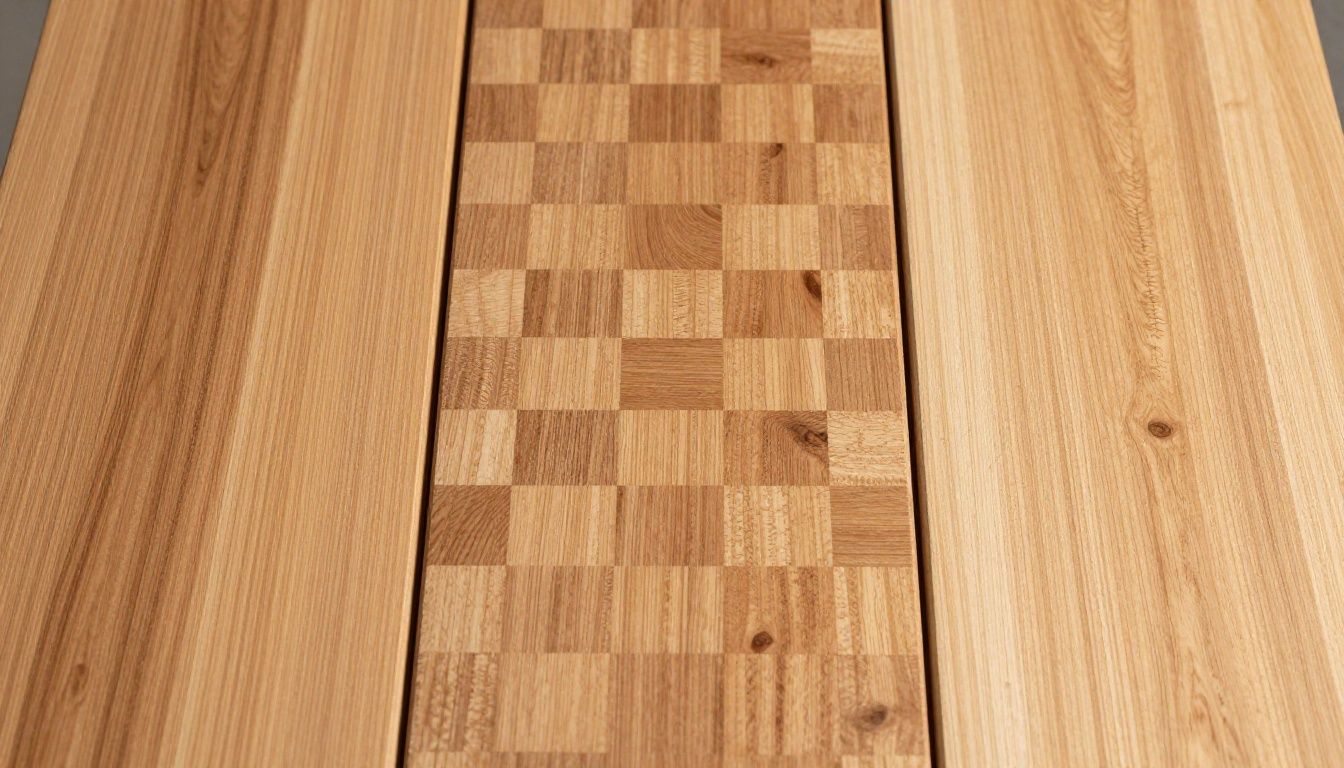
Edge grain places the long edges of boards at the working surface. Narrow strips are laminated side by side, producing a relatively stable slab with a conventional timber appearance. It is suitable for islands, eating counters, and many preparation surfaces when properly sealed.
End grain, often associated with butcher block, places the cut ends of short wood blocks at the surface. The exposed fibres can absorb knife impact and are gentler on blades than a hard, sealed edge-grain top. It is also the heaviest and most labour-intensive option. A true cutting block should not be treated like a decorative counter, because knife marks and refinishing are part of its use.
Face grain uses the broad face of the board at the surface. It gives a more continuous, furniture-like pattern and can work well where the counter is primarily visual. It is less forgiving of dents, scratches, and movement than a properly constructed edge-grain top.
| Construction | Typical use | Relative cost | Main advantage | Main limitation |
|---|---|---|---|---|
| Edge grain | Islands, perimeter counters, eating ledges | Medium | Stable, versatile appearance | Needs sealing and periodic maintenance |
| End grain | Dedicated chopping blocks, butcher block islands | High | Durable cutting surface, repairs well | Heavy, expensive, not ideal beside a sink |
| Face grain | Decorative islands and accent counters | Medium to high | Broad, furniture-like grain | Movement and wear are more visible |
The phrase “butcher block countertops Vancouver” covers several products, so confirm the construction rather than relying on the label. Ask whether the boards are edge, end, or face grain, what adhesive is used, whether the top is intended for cutting, and how the finish should be renewed.
The direction of the wood fibres changes the counter’s appearance, movement, repairability, and intended use.
Which species should you choose for a wood kitchen countertop?
Choose a species based on hardness, grain movement, colour change, availability, and the finish you are prepared to maintain. Maple and white oak are common practical choices; walnut is valued for colour but usually costs more; teak has useful moisture resistance but is not a universal solution.
- Hard maple: Fine, light, and relatively uniform. It suits a clean butcher-block appearance and handles ordinary kitchen wear well. Its pale colour also makes water marks more visible.
- White oak: Strong, widely used, and visually forgiving because of its open grain. It works with painted, stained, and natural cabinetry, but the open grain may require more attention during finishing.
- Walnut: Darker and more furniture-like, with a higher material cost in many projects. Scratches may blend into the colour, but excessive direct sunlight can alter the tone.
- Teak: Naturally oily and comparatively resistant to moisture, but it can complicate glue-up and finishing. It should be specified by a fabricator familiar with the species rather than selected solely for water resistance.
- Reclaimed wood: Offers character but brings variable moisture content, old fastener risk, inconsistent hardness, and additional preparation. It is usually a design decision, not a cost-saving measure.
A harder wood is not automatically better. Very hard species can be less comfortable to work on, harder on knives, and more difficult to machine cleanly. Stable, properly dried stock and sound construction matter at least as much as the species name.
What do wood countertops cost in Vancouver?
Installed wood countertop pricing commonly falls between $150 and $350 per square foot for a residential renovation. That is a planning range, not a quote. A straightforward edge-grain maple island may sit near the lower part of the range, while walnut, end grain, waterfall ends, integrated drain details, multiple cutouts, or difficult access can move the project well above it.
For comparison, quartz is often priced in a similar broad project band, commonly around $120–$250 per square foot installed, although local fabrication, slab selection, thickness, edge profile, and installation conditions change the number. The useful comparison is not only material price; it is also care, repairability, seams, and what happens when the surface is damaged.
| Cost item | Planning range | What moves it higher or lower |
|---|---|---|
| Standard edge-grain wood top | $150–$250/sq. ft. installed | Species, thickness, finish, edge profile |
| Premium walnut or specialty species | $200–$350+/sq. ft. installed | Stock availability, colour matching, waste |
| End-grain butcher block | $250–$400+/sq. ft. installed | Block size, thickness, weight, custom fabrication |
| Sink or cooktop cutout | $300–$900 each | Cutout shape, sink type, reinforcement, finishing |
| Removal and disposal of existing top | $500–$1,500/project | Material weight, access, plumbing and backsplash condition |
| Refinishing an existing wood top | $15–$35/sq. ft. | Damage depth, stripping, sanding, repairs, site access |
These figures exclude unusual structural work, plumbing changes, electrical relocation, cabinet modifications, and extensive backsplash repairs. A narrow Vancouver condo stairwell or a building with restricted elevator access can also affect labour and delivery.
The finish is part of the price, not a minor afterthought. A factory-applied catalyzed finish may reduce routine oiling but can be harder to spot-repair. A penetrating oil or hardwax oil can be renewed locally, but it typically requires more regular attention and does not make the surface waterproof.
For a wider view of the decision, compare this material choice with the cost and long-term value considerations in Are Custom Cabinets Worth It?. The counter should be evaluated as part of the cabinet and installation scope, not as an isolated square-foot purchase.
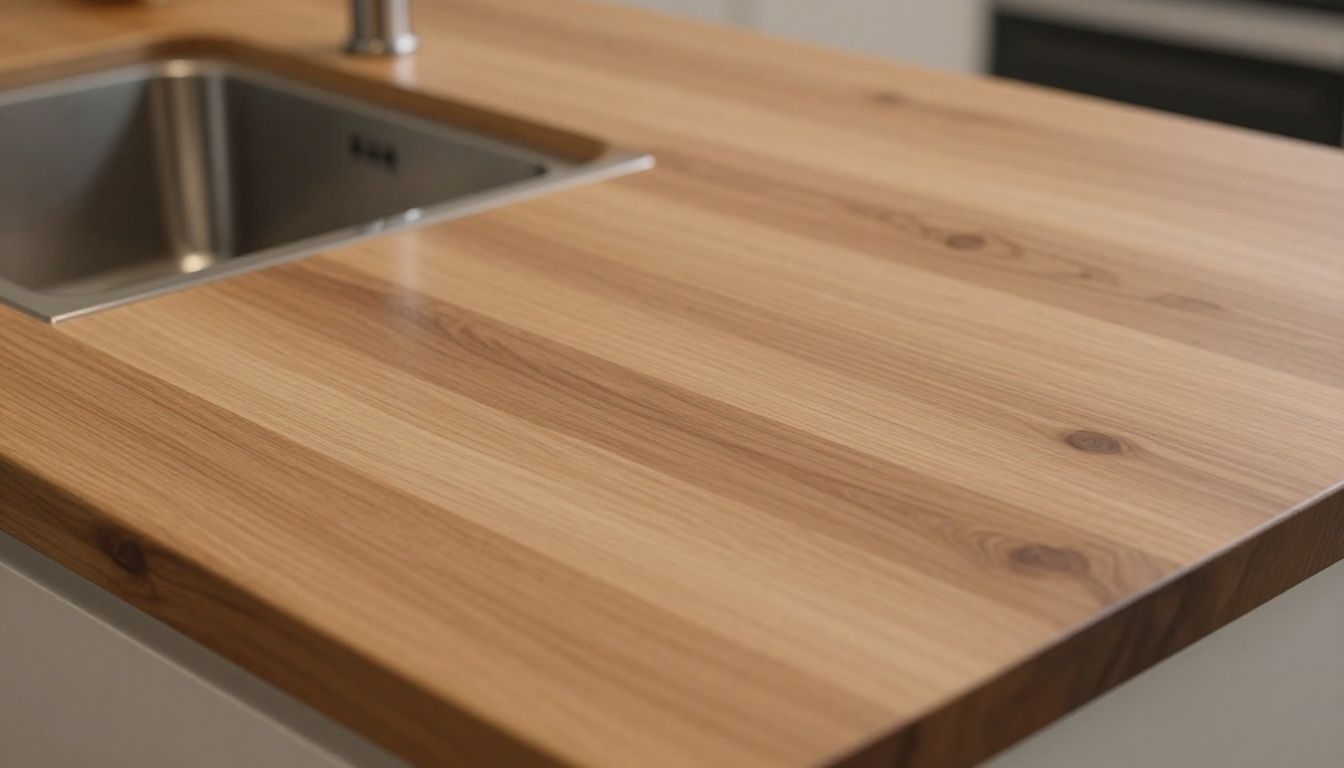
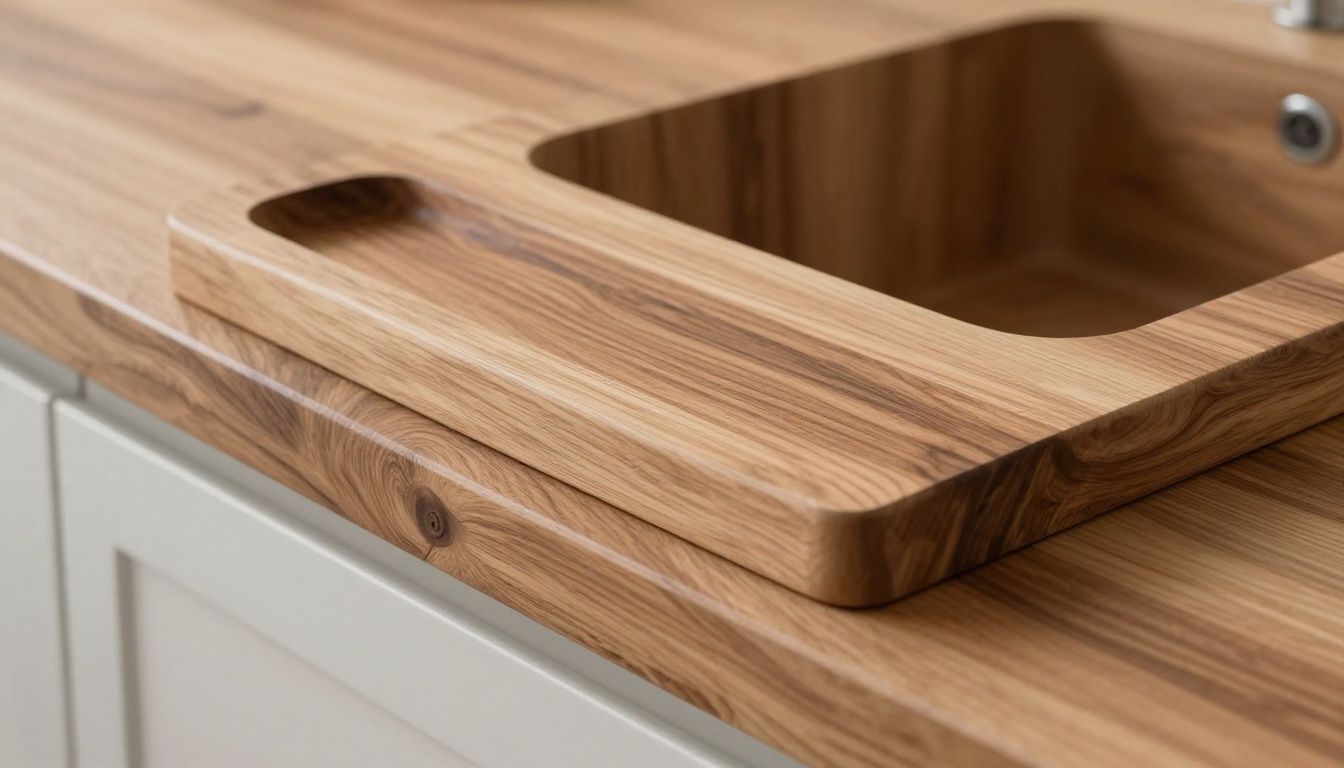
Sink cutouts and exposed ends deserve particular attention because they receive concentrated moisture and require careful finishing.
How should a wood counter be built around a sink?
Treat the sink area as the highest-risk location and specify it before fabrication. An undermount sink can provide a clean appearance, but its exposed wood edge must be sealed thoroughly and kept free of standing water. A top-mount sink leaves less exposed cutout edge but introduces a rim and sealant joint that must be maintained.
The fabricator should seal the cutout, underside, front edge, and any seam—not only the visible top. End grain at a cutout absorbs finish differently from the broad face, so it may need additional coats or a compatible edge treatment. The dishwasher opening also needs protection from warm, moist air released when the door opens.
A wood top should not be fastened rigidly across its full width. Slotted clips, figure-eight fasteners, or another movement-tolerant method allow seasonal expansion and contraction. The installer must also maintain the manufacturer’s clearances around appliances and avoid trapping the counter between fixed walls without an engineered movement detail.
A practical site scenario
Consider a 96-inch island with an undermount prep sink and a quartz perimeter around the range and main sink. The wood island receives occasional splashes but not the daily wetting caused by dishwashing. That division gives the homeowner the warmer surface they wanted while keeping the highest-moisture work zone on a lower-maintenance material.
How often do wood kitchen countertops need oiling and sealing?
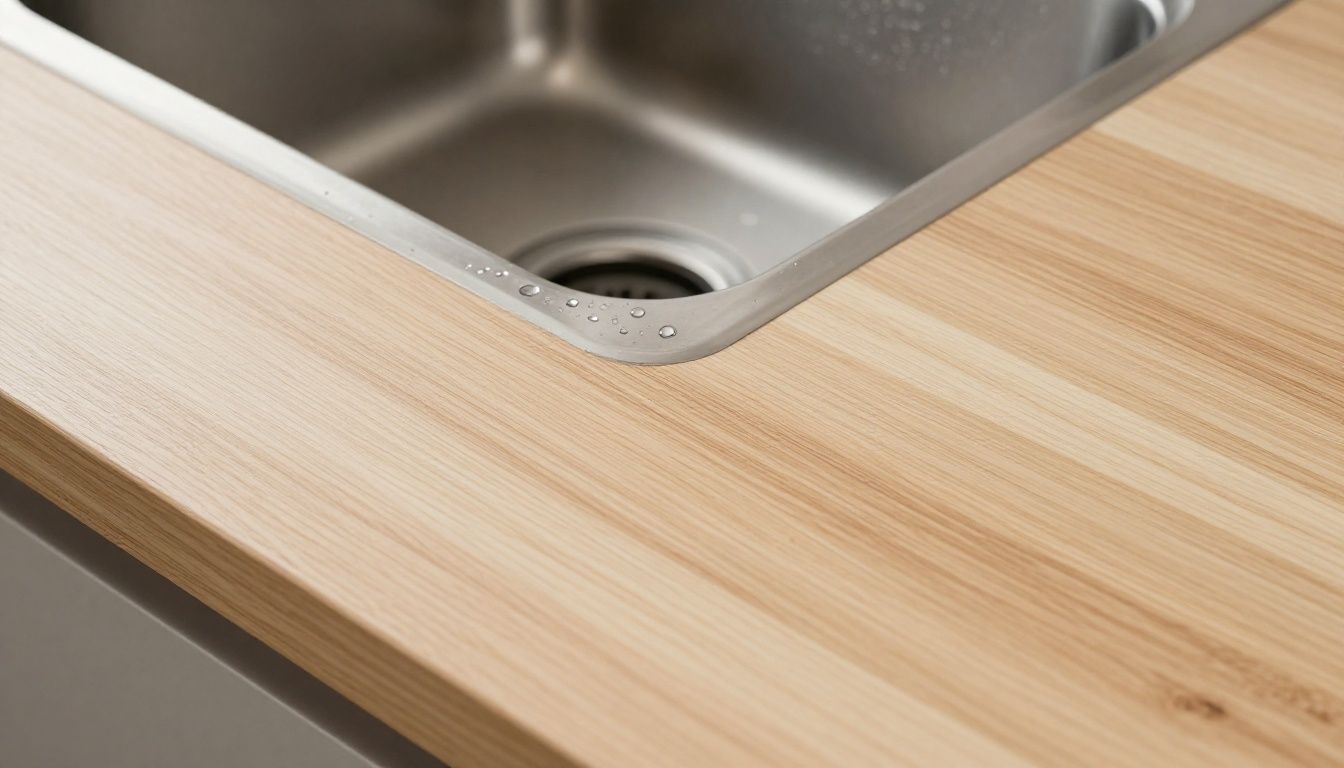
Follow the finish manufacturer’s schedule, but expect more attention during the first year. A penetrating oil may need maintenance every few weeks initially and then every few months, depending on use, sheen, and water behaviour. A hardwax oil may require less frequent renewal, while a film finish can last longer before recoating but may need sanding and repair when breached.
There is no reliable universal interval because a lightly used island and a family sink run do not experience the same wear. The useful test is behaviour: if water no longer beads briefly, the surface looks dry or pale, or small areas darken after contact, maintenance is due. Do not wait until a black ring or raised joint appears.
Daily care is simple but important. Wipe spills promptly, use trivets under hot cookware, keep appliances from trapping moisture, and do not leave wet cloths on seams or end grain. Clean with a damp cloth and a mild product approved for the finish. Avoid bleach, abrasive powders, soaking, and generic oil unless the fabricator confirms compatibility.
For homeowners who want a documented maintenance approach, the cabinet care guide for Vancouver homeowners also provides useful principles for protecting adjacent cabinetry and finished millwork.
Maintenance should begin before water marks appear and should use only the finish system specified for the counter.
Does Vancouver humidity make wood countertops move?
Yes, wood moves with changes in moisture content, but correct construction manages that movement. Keep indoor conditions reasonably stable, allow the counter to acclimatize before installation, and avoid fastening methods that prevent the slab from expanding across its width.
A typical wood top may be approximately 1 1/4 to 1 1/2 inches thick, though custom work can be thicker. The required support depends on the span, overhang, species, construction, and cutouts. As a general design reference, an unsupported seating overhang is often limited to roughly 10–12 inches without additional brackets or structural support; the cabinetmaker and engineer should confirm the actual condition.
The National Kitchen & Bath Association (NKBA) publishes planning guidance for kitchen clearances, but its recommendations are not a substitute for structural design or local code review. For renovation work in British Columbia, confirm applicable requirements with the BC Building Code and the authority having jurisdiction, especially when cabinetry, plumbing, or electrical work changes.
Can you combine wood countertops with quartz?
Yes. Wood and quartz work well together when each material is assigned a suitable task. Quartz is better for the main sink, range landing areas, and surfaces exposed to frequent spills, while wood adds warmth to an island, baking station, or breakfast counter.
Keep the relationship deliberate. Matching the wood to flooring is not required, and trying to make two materials appear identical can make small colour differences more noticeable. Instead, coordinate undertones, cabinet finish, hardware, and edge profiles. A 1 1/2-inch wood edge beside a 2-centimetre quartz slab can look unbalanced unless the transition is designed carefully.
The joint between materials also requires planning. Separate cabinet runs usually make the transition straightforward. On one continuous island, a change in material can require a supporting rail, a seam detail, and allowance for different movement characteristics. Quartz is dimensionally stable compared with solid wood, so the connection should not force the wood to move with it.
The two materials should meet at a planned cabinet or structural line rather than at an improvised field seam.
Where does wood fail as a countertop choice?
Wood is a poor choice where the owner wants zero maintenance, routinely cuts directly on the finished surface, or cannot control moisture around a sink. It is also a weak choice for a narrow strip behind a faucet if that strip will collect water and cannot be wiped easily.
It can fail aesthetically when the selected grain is too busy beside heavily patterned cabinetry or when the finish colour changes more than expected. It can fail technically when the counter is installed before the room is ready, stored in an unconditioned space, or fixed tightly between walls.
The right question is not “Is wood durable?” The better question is “Can this location, construction, finish, and maintenance plan support wood?” If the answer is no, use quartz, porcelain, or another material in that zone and reserve wood for a controlled application.
What should you confirm before ordering?
Request a written specification covering species, construction, thickness, finish, edge profile, sink treatment, backsplash or wall returns, overhang support, seam locations, acclimatization, and care products. Confirm whether the price includes templating, delivery, installation, plumbing reconnection, removal, and disposal.
Measure only after cabinets are installed or fully verified. A countertop order based on preliminary cabinet dimensions can miss wall irregularities, filler changes, appliance panels, and the actual sink model. On a renovation, those errors can create a second fabrication charge and delay the installation sequence.
Review the installation scope with the shop providing the countertop installation. A good installation is not simply placing a slab on boxes; it includes support, movement allowance, cutout protection, seams, wall conditions, and coordination with plumbing and appliances.
Final recommendation for wood kitchen countertops in Vancouver
Wood kitchen countertops in Vancouver make sense when the surface is selected for its location, built for movement, sealed on every exposed face, and maintained according to its finish. Edge-grain maple or oak is the practical starting point for most projects. End grain belongs where its cutting performance justifies the cost, and face grain is best treated as a decorative or lightly used surface.
For many homes, a wood island with quartz around the sink and range offers the most balanced result. If you want to compare finished examples and installation approaches, review the Kitchen & Bath Renovation Portfolio before requesting a consultation with Final Draft Cabinetry.
FAQ
Are butcher block countertops sanitary around a kitchen sink?
They can be sanitary when the finish is intact, the surface is cleaned correctly, and water is not allowed to remain at the sink edge. A wood counter is not self-sanitizing, and cutting directly on a sealed surface can damage the finish. For heavy wet use, quartz is usually simpler to maintain.
Can a wood countertop be repaired if it gets stained?
Usually, shallow stains and scratches can be sanded and refinished, provided the damage has not penetrated through a seam or caused structural swelling. Deep black staining, delamination, or a distorted sink cutout may require a replacement section or new top. The repair method depends on the finish and construction.
Should a wood countertop be used beside a gas cooktop?
It can be used beside a gas cooktop if the appliance manufacturer’s clearances, heat protection, and installation requirements are met. Do not assume a wood edge is safe because the counter is thick. A fabricator should coordinate the cutout, nearby overhang, heat exposure, and any required noncombustible materials.
Is an undermount sink or top-mount sink better with wood?
A top-mount sink generally exposes less cutout edge and can be more forgiving in a high-moisture area. An undermount sink gives a cleaner transition but requires meticulous sealing and prompt drying. The better choice depends on the finish, sink design, maintenance habits, and quality of the cutout fabrication.
Can wood countertops be installed over existing cabinets?
They can be installed over existing cabinets if the boxes are level, adequately supported, structurally sound, and correctly positioned for the new top. Existing cabinets may need fillers, levelling, reinforcement, or modifications around appliances. A site measure should confirm those conditions before the material is ordered.
How long does fabrication and installation usually take?
A straightforward custom wood top commonly requires several weeks from approved drawings and deposit to installation, although the exact schedule depends on material availability, finishing, templating, and the renovation sequence. Longer timelines are normal for specialty species, end grain, complex cutouts, or projects waiting on cabinet completion.